Demonstration of hii_region_model
Bayesian kinematic distance calculator.
Trey Wenger, 2025
[1]:
import pickle
import numpy as np
from scipy.stats import multivariate_normal
import pymc as pm
import arviz as az
import pandas as pd
import matplotlib.pyplot as plt

from physiokinematic.hii_region_model import hii_region_model
[2]:
# Load Reid et al. (2019) rotation curve parameters
with open("../../../data/reid19_params.pkl", "rb") as f:
    reid19_params = pickle.load(f)
print(reid19_params.keys())

samples = reid19_params['full'].resample(1_000)

# R0, Usun, Vsun, Wsun, a2, a3
samples = samples[np.array([0,1,2,3,6,7]), :]

reid19_fit = multivariate_normal.fit(samples.T)
dict_keys(['R0', 'Usun', 'Vsun', 'Wsun', 'Upec', 'Vpec', 'a2', 'a3', 'full'])
/tmp/ipykernel_331801/3720529096.py:3: DeprecationWarning: Please import `gaussian_kde` from the `scipy.stats` namespace; the `scipy.stats.kde` namespace is deprecated and will be removed in SciPy 2.0.0.
  reid19_params = pickle.load(f)
[3]:
hii_data = pd.read_csv("../../../data/hii_data.csv")
data = hii_data.iloc[550].copy()
data
[3]:
gname                   G035.126-00.755
glong                            35.126
glat                          -0.754265
radius                          169.392
vlsr                               34.5
e_vlsr                              0.1
line                              29.48
e_line                            0.204
line_unit                      mJy/beam
beam_area                   6893.719776
line_freq                        8000.0
fwhm                               19.7
e_fwhm                              0.2
te                                  NaN
e_te                              500.0
source                     WISE Catalog
author          Anderson et al. (2015b)
telescope                           GBT
kdar                                  N
Rgal                           6.567508
near                           2.055998
far                           11.270497
tangent                        6.676467
vlsr_tangent                  96.219351
plx                                 NaN
dist_author                         NaN
te_priority                           0
Name: 550, dtype: object
[4]:
model = hii_region_model(
    data, # HII region data
    reid19_fit[0], # Prior mean on rotation curve parameters
    reid19_fit[1], # Prior covariance on rotation curve parameters
    prior_Rgal = 5.0, # Prior width on Galactocentric radius (kpc)
    prior_te_offset = [4500.0, 200.0], # Prior mean and width on electron temperature gradient offset (K)
    prior_te_slope = [360.0, 25.0], # Prior mean and width on elecron temperature gradient slope (K/kpc)
    prior_log10_q = [47.0, 2.0], # Prior mean and width on log10 ionizing photon rate (s-1)
    prior_log10_ne = [1.0, 2.0], # Prior mean and width on log10 electron density (cm-3)
    prior_kdar = [0.5, 0.5], # Prior shape for kinematic distance ambiguity resolution
    log10_radius_sigma = 0.1, # Apparent radius likelihood width
    log10_line_sigma = 0.2, # Line brightness likelihood width
    vlsr_sigma = 10.0, # Assumed LSR velocity systematic uncertainty (km/s)
    te_sigma = 500.0, # Assumed electron temperature systematic uncertainty (K)
)
[5]:
model
[5]:
$$
\begin{array}{rcl}
\text{rotcurve} &\sim & \operatorname{MultivariateNormal}(f(),~\text{<constant>})\\\text{Rgal_norm} &\sim & \operatorname{Gamma}(0.5,~f())\\\text{te_offset_norm} &\sim & \operatorname{Normal}(0,~1)\\\text{te_slope_norm} &\sim & \operatorname{Normal}(0,~1)\\\text{te_norm} &\sim & \operatorname{Normal}(0,~1)\\\text{kdar_w} &\sim & \operatorname{Categorical}(\text{<constant>})\\\text{log10_q_norm} &\sim & \operatorname{Normal}(0,~1)\\\text{log10_ne_norm} &\sim & \operatorname{Normal}(0,~1)\\\text{Rgal} &\sim & \operatorname{Deterministic}(f(\text{Rgal_norm},~\text{rotcurve}))\\\text{te_offset} &\sim & \operatorname{Deterministic}(f(\text{te_offset_norm}))\\\text{te_slope} &\sim & \operatorname{Deterministic}(f(\text{te_slope_norm}))\\\text{te} &\sim & \operatorname{Deterministic}(f(\text{te_norm},~\text{te_offset_norm},~\text{te_slope_norm},~\text{Rgal_norm},~\text{rotcurve}))\\\text{distance} &\sim & \operatorname{Deterministic}(f(\text{rotcurve},~\text{Rgal_norm}))\\\text{abs_distance} &\sim & \operatorname{Deterministic}(f(\text{rotcurve},~\text{Rgal_norm}))\\\text{log10_q} &\sim & \operatorname{Deterministic}(f(\text{log10_q_norm}))\\\text{log10_ne} &\sim & \operatorname{Deterministic}(f(\text{log10_ne_norm}))\\\text{log10_Rs} &\sim & \operatorname{Deterministic}(f(\text{log10_q_norm},~\text{log10_ne_norm}))\\\text{log10_em} &\sim & \operatorname{Deterministic}(f(\text{log10_ne_norm},~\text{log10_q_norm}))\\\text{log10_radius_mu} &\sim & \operatorname{Deterministic}(f(\text{log10_q_norm},~\text{log10_ne_norm},~\text{rotcurve},~\text{Rgal_norm}))\\\text{log10_tau_line} &\sim & \operatorname{Deterministic}(f(\text{log10_ne_norm},~\text{te_norm},~\text{log10_q_norm},~\text{te_offset_norm},~\text{te_slope_norm},~\text{Rgal_norm},~\text{rotcurve}))\\\text{log10_line_mu} &\sim & \operatorname{Deterministic}(f(\text{te_norm},~\text{te_offset_norm},~\text{te_slope_norm},~\text{Rgal_norm},~\text{rotcurve},~\text{log10_ne_norm},~\text{log10_q_norm}))\\\text{vlsr_obs} &\sim & \operatorname{Normal}(f(\text{rotcurve},~\text{Rgal_norm}),~f())\\\text{log10_radius_obs} &\sim & \operatorname{Normal}(f(\text{kdar_w},~\text{log10_q_norm},~\text{log10_ne_norm},~\text{rotcurve},~\text{Rgal_norm}),~0.1)\\\text{log10_line_obs} &\sim & \operatorname{Normal}(f(\text{kdar_w},~\text{te_norm},~\text{te_offset_norm},~\text{te_slope_norm},~\text{Rgal_norm},~\text{rotcurve},~\text{log10_q_norm},~\text{log10_ne_norm}),~0.2)
\end{array}
$$
[6]:
# sample prior predictive
with model:
    prior = pm.sample_prior_predictive(1_000)
Sampling: [Rgal_norm, kdar_w, log10_line_obs, log10_ne_norm, log10_q_norm, log10_radius_obs, rotcurve, te_norm, te_offset_norm, te_slope_norm, vlsr_obs]
[7]:
# plot prior samples
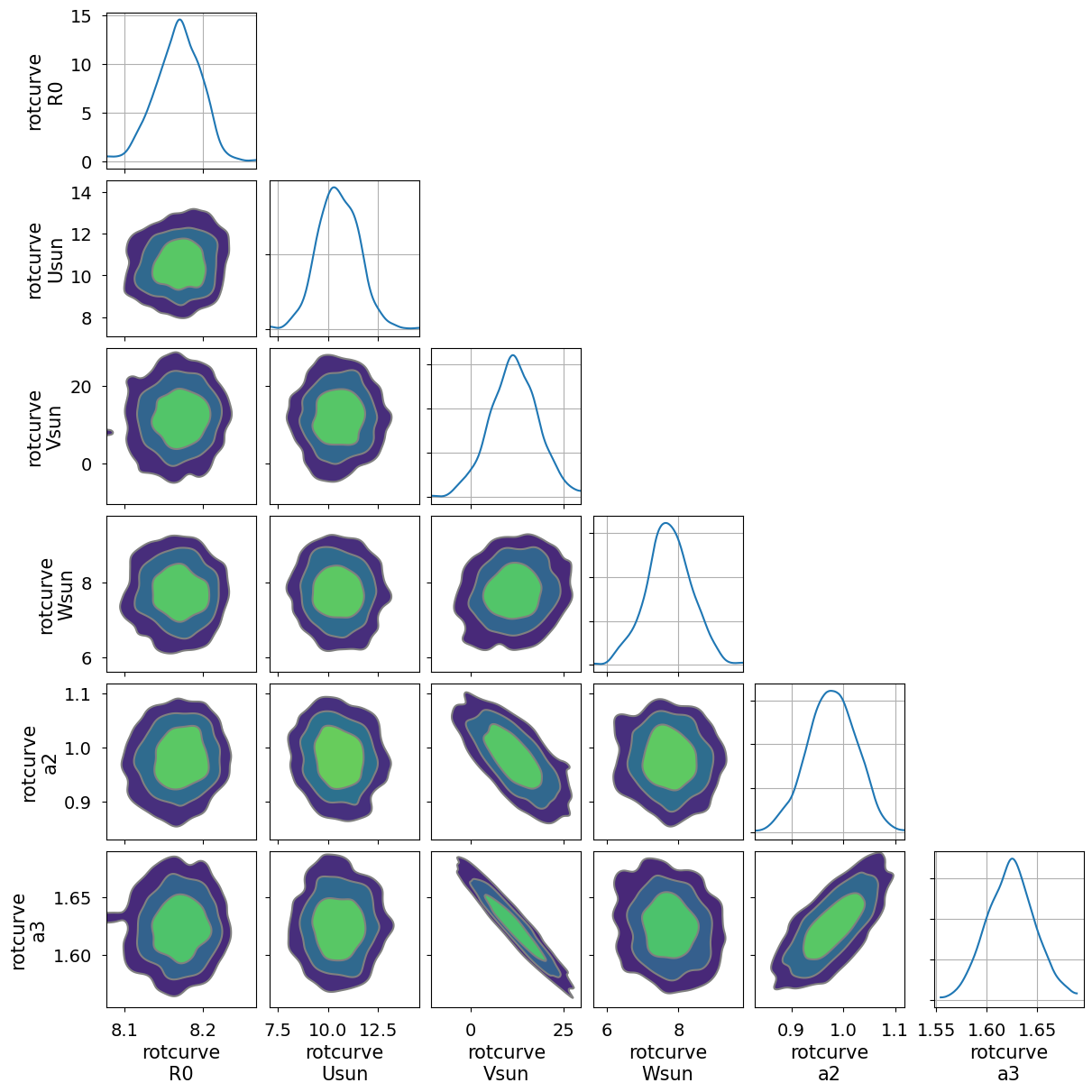
_ = pm.plot_pair(prior.prior["rotcurve"], marginals=True, figsize=(12, 12), kind='kde', backend_kwargs={"layout": "constrained"})
[8]:
# plot prior samples
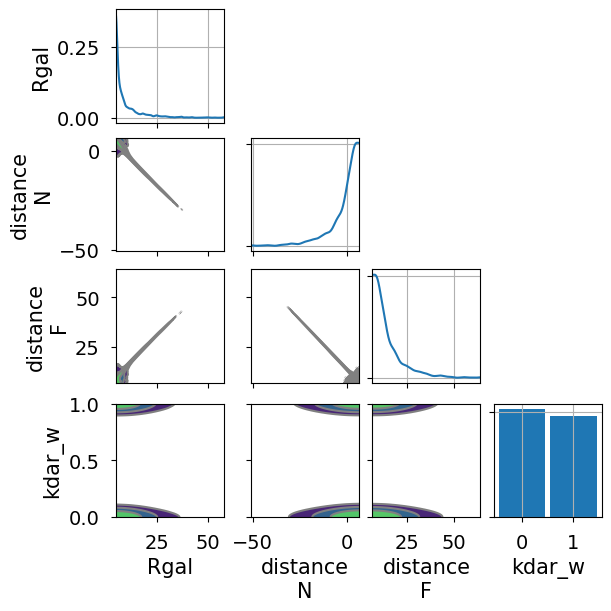
_ = pm.plot_pair(prior.prior, marginals=True, figsize=(6, 6), kind='kde', backend_kwargs={"layout": "constrained"}, var_names=["Rgal", "distance", "kdar_w"])
[9]:
# plot prior samples
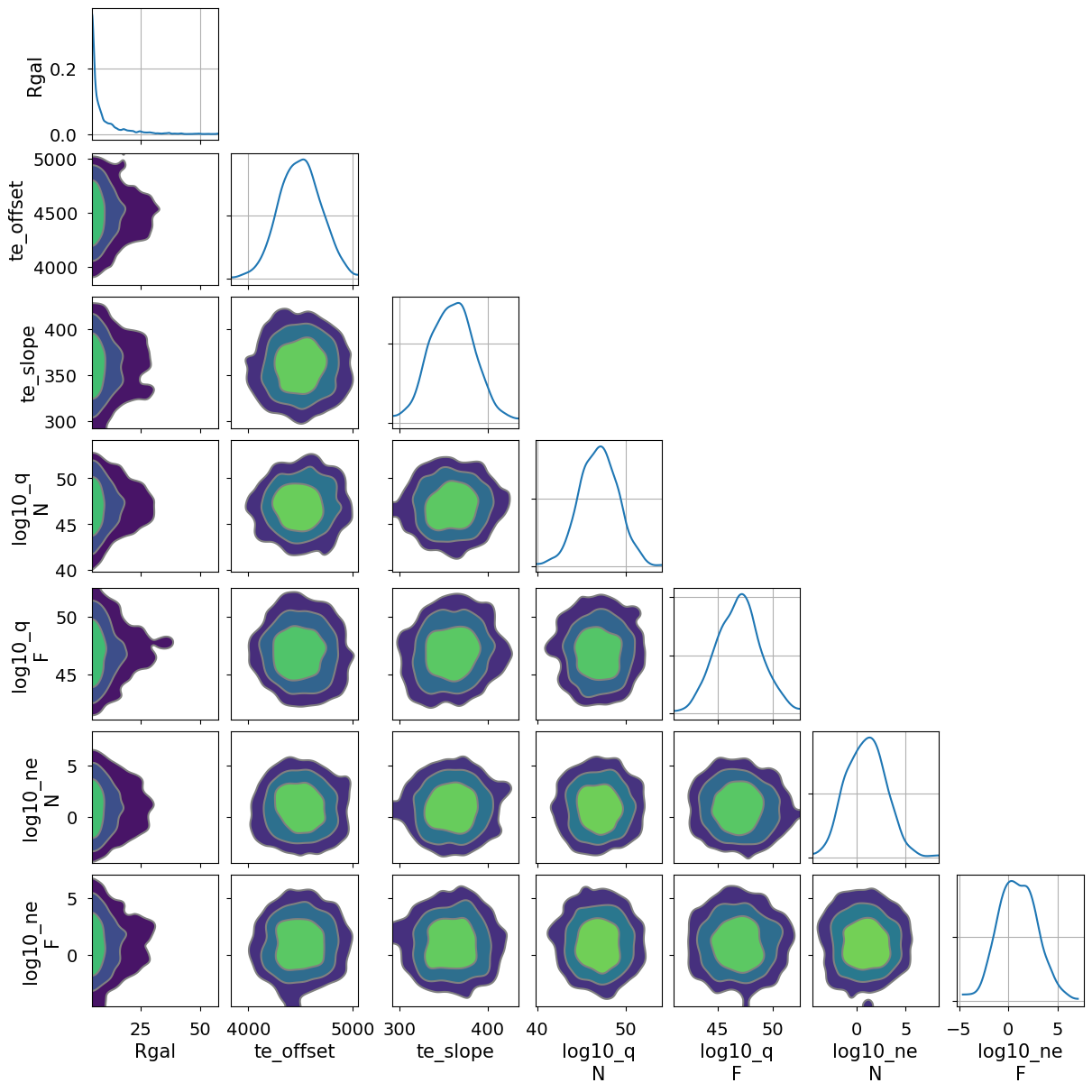
_ = pm.plot_pair(prior.prior, marginals=True, figsize=(12, 12), kind='kde', backend_kwargs={"layout": "constrained"}, var_names=["Rgal", "te_offset", "te_slope", "log10_q", "log10_ne"])
[10]:
# The model is multi-modal, so we sample with SMC
with model:
    trace = pm.sample_smc()
Initializing SMC sampler...
Sampling 12 chains in 12 jobs
|████████████████████████████████████████| 100.00% [100/100 00:00<? Stage: 5 Beta: 1.000]
/home/twenger/miniforge3/envs/physiokinematic/lib/python3.12/site-packages/arviz/data/base.py:272: UserWarning: More chains (12) than draws (6). Passed array should have shape (chains, draws, *shape)
  warnings.warn(
[11]:
az.summary(trace, hdi_prob=0.68, var_names=["rotcurve", "Rgal", "distance", "kdar_w", "te_offset", "te_slope", "te", "log10_q", "log10_ne", "log10_Rs", "log10_em"])
[11]:
| mean | sd | hdi_16% | hdi_84% | mcse_mean | mcse_sd | ess_bulk | ess_tail | r_hat | |
|---|---|---|---|---|---|---|---|---|---|
| rotcurve[R0] | 8.169 | 0.027 | 8.142 | 8.195 | 0.000 | 0.000 | 4827.0 | 6154.0 | 1.00 |
| rotcurve[Usun] | 10.472 | 1.000 | 9.516 | 11.500 | 0.014 | 0.010 | 5528.0 | 5232.0 | 1.00 |
| rotcurve[Vsun] | 12.239 | 6.206 | 6.272 | 18.415 | 0.084 | 0.063 | 5542.0 | 6083.0 | 1.00 |
| rotcurve[Wsun] | 7.729 | 0.603 | 7.141 | 8.346 | 0.009 | 0.006 | 4877.0 | 4900.0 | 1.00 |
| rotcurve[a2] | 0.977 | 0.044 | 0.937 | 1.024 | 0.001 | 0.000 | 5032.0 | 5156.0 | 1.00 |
| rotcurve[a3] | 1.622 | 0.023 | 1.600 | 1.645 | 0.000 | 0.000 | 5711.0 | 4945.0 | 1.00 |
| Rgal | 6.575 | 0.443 | 6.133 | 6.992 | 0.005 | 0.003 | 7061.0 | 9005.0 | 1.00 |
| distance[N] | 2.106 | 0.640 | 1.521 | 2.763 | 0.008 | 0.005 | 7007.0 | 9323.0 | 1.00 |
| distance[F] | 11.256 | 0.639 | 10.621 | 11.860 | 0.008 | 0.005 | 7058.0 | 9015.0 | 1.00 |
| kdar_w | 0.666 | 0.471 | 0.000 | 1.000 | 0.008 | 0.003 | 3457.0 | 3457.0 | 1.01 |
| te_offset | 4497.532 | 192.992 | 4300.229 | 4687.081 | 2.448 | 1.692 | 6249.0 | 6044.0 | 1.00 |
| te_slope | 360.109 | 24.991 | 335.782 | 384.921 | 0.344 | 0.287 | 5285.0 | 5046.0 | 1.00 |
| te | 6861.651 | 567.517 | 6314.482 | 7427.825 | 7.463 | 5.651 | 5760.0 | 3964.0 | 1.00 |
| log10_q[N] | 46.355 | 1.667 | 44.691 | 47.650 | 0.023 | 0.016 | 5415.0 | 5771.0 | 1.00 |
| log10_q[F] | 46.789 | 0.908 | 46.280 | 47.115 | 0.020 | 0.027 | 2790.0 | 1480.0 | 1.01 |
| log10_ne[N] | 1.320 | 1.531 | -0.012 | 2.537 | 0.020 | 0.018 | 6291.0 | 5386.0 | 1.01 |
| log10_ne[F] | 1.445 | 0.980 | 1.210 | 1.986 | 0.025 | 0.036 | 2492.0 | 591.0 | 1.00 |
| log10_Rs[N] | 0.718 | 1.219 | -0.336 | 1.751 | 0.016 | 0.013 | 6227.0 | 5621.0 | 1.00 |
| log10_Rs[F] | 0.779 | 0.699 | 0.456 | 0.887 | 0.017 | 0.025 | 2413.0 | 674.0 | 1.01 |
| log10_em[N] | 3.659 | 2.051 | 1.671 | 5.156 | 0.026 | 0.025 | 6306.0 | 4964.0 | 1.01 |
| log10_em[F] | 3.970 | 1.363 | 3.515 | 4.725 | 0.034 | 0.050 | 2467.0 | 1300.0 | 1.01 |
[12]:
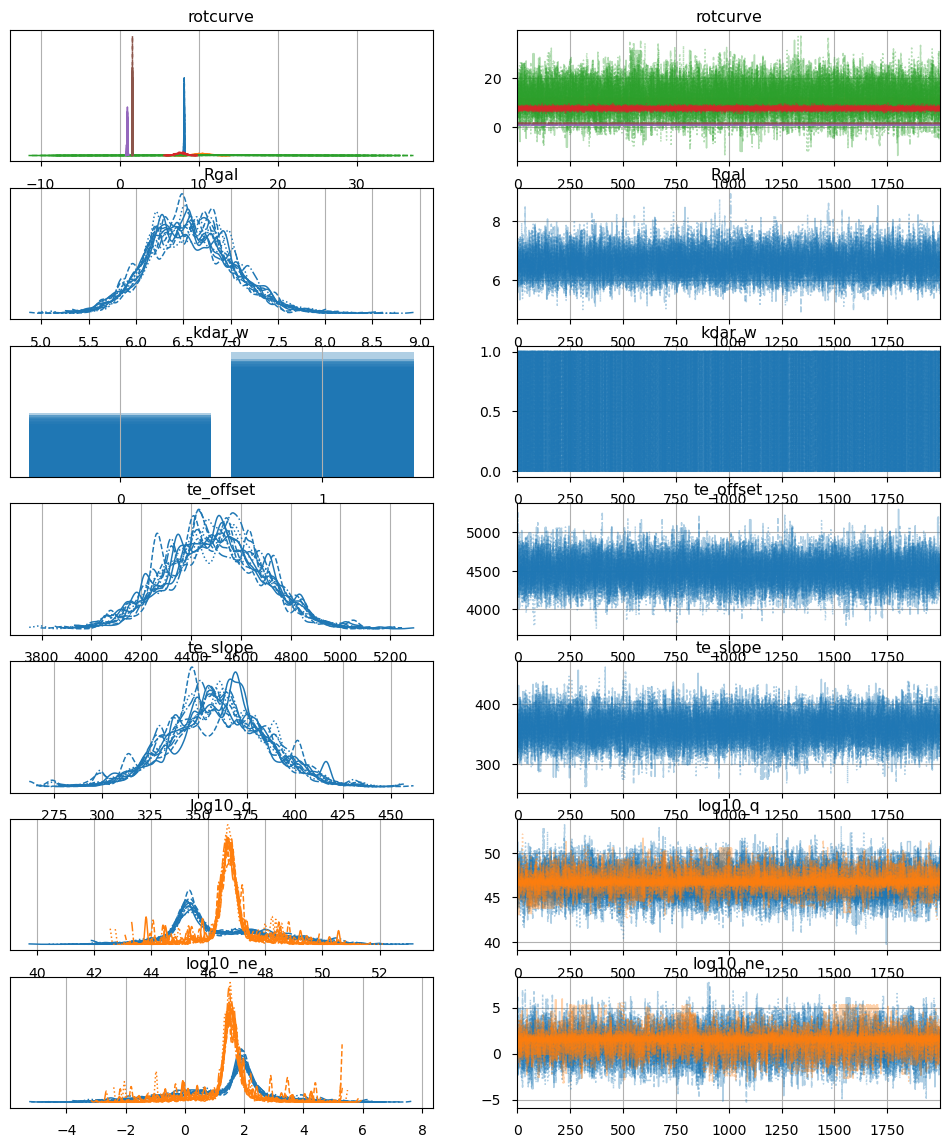
_ = pm.plot_trace(trace.posterior, var_names=["rotcurve", "Rgal", "kdar_w", "te_offset", "te_slope", "log10_q", "log10_ne"])
[13]:
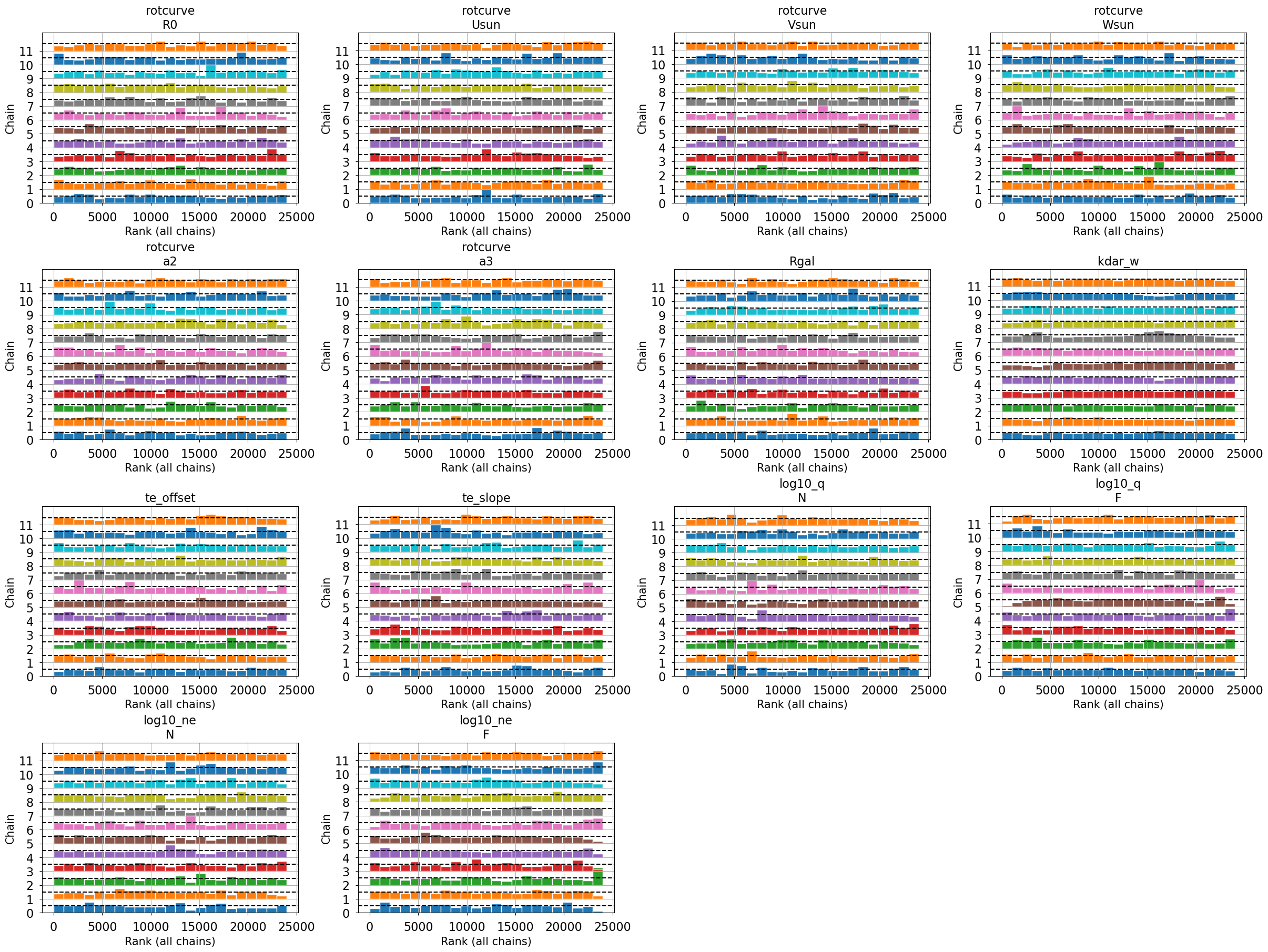
_ = pm.plot_rank(trace.posterior, var_names=["rotcurve", "Rgal", "kdar_w", "te_offset", "te_slope", "log10_q", "log10_ne"], figsize=(24, 18), backend_kwargs={"layout": "constrained"})
[14]:
# plot posterior samples
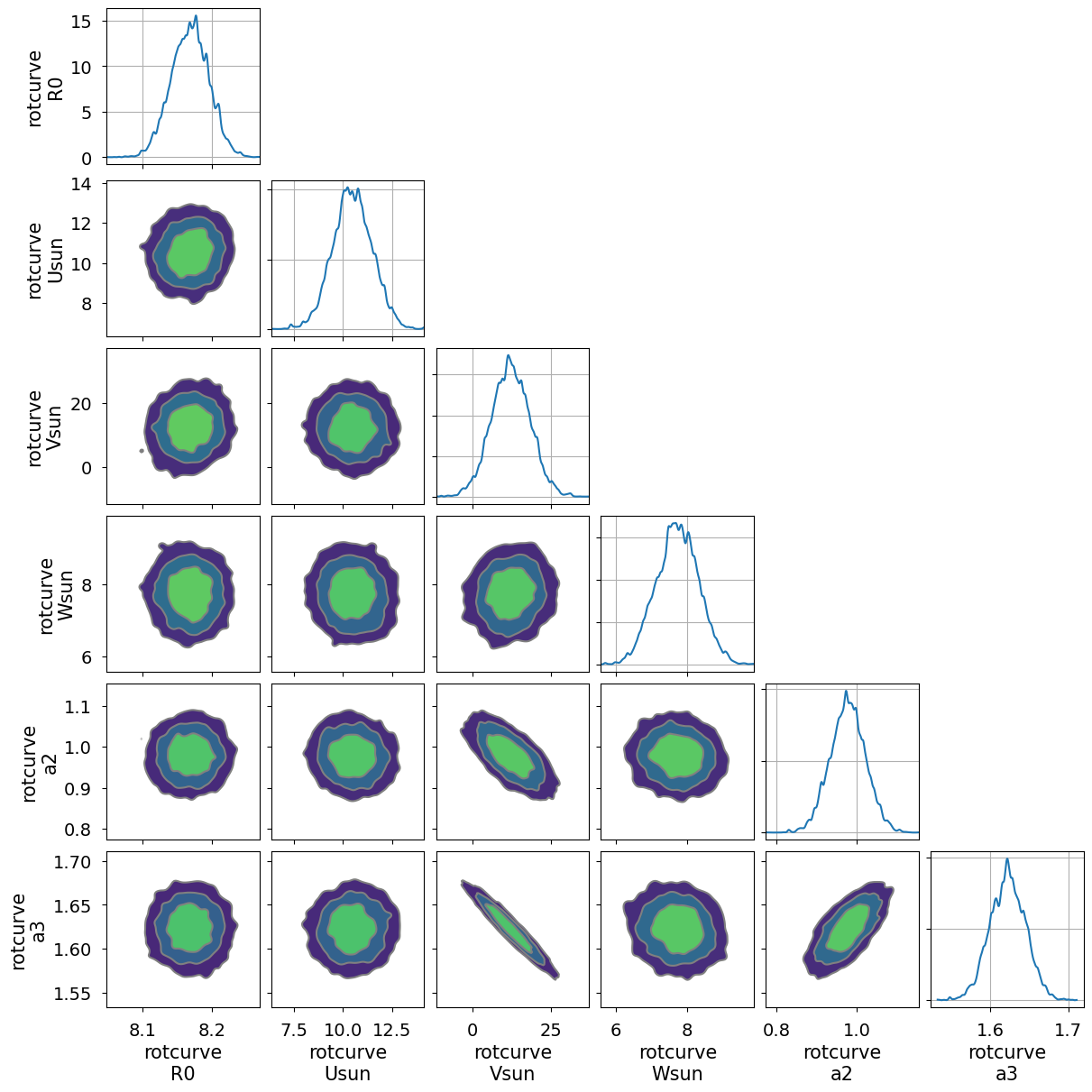
_ = pm.plot_pair(trace.posterior["rotcurve"], marginals=True, figsize=(12, 12), kind='kde', backend_kwargs={"layout": "constrained"})
[15]:
# plot posterior samples
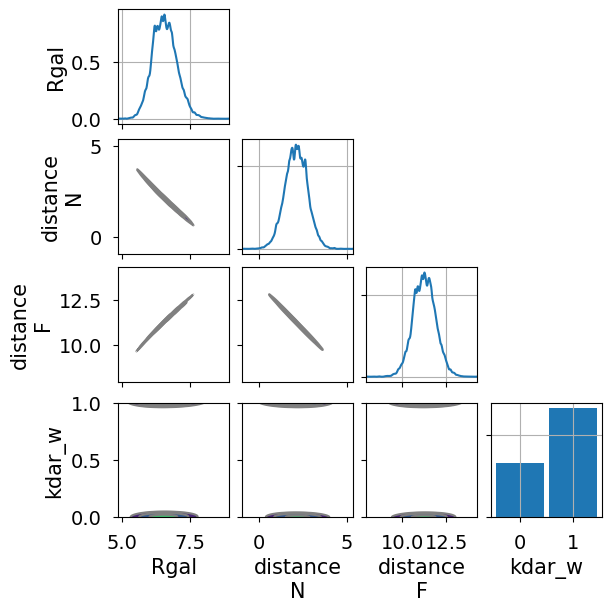
_ = pm.plot_pair(trace.posterior, marginals=True, figsize=(6, 6), kind='kde', backend_kwargs={"layout": "constrained"}, var_names=["Rgal", "distance", "kdar_w"])
[16]:
# plot posterior samples
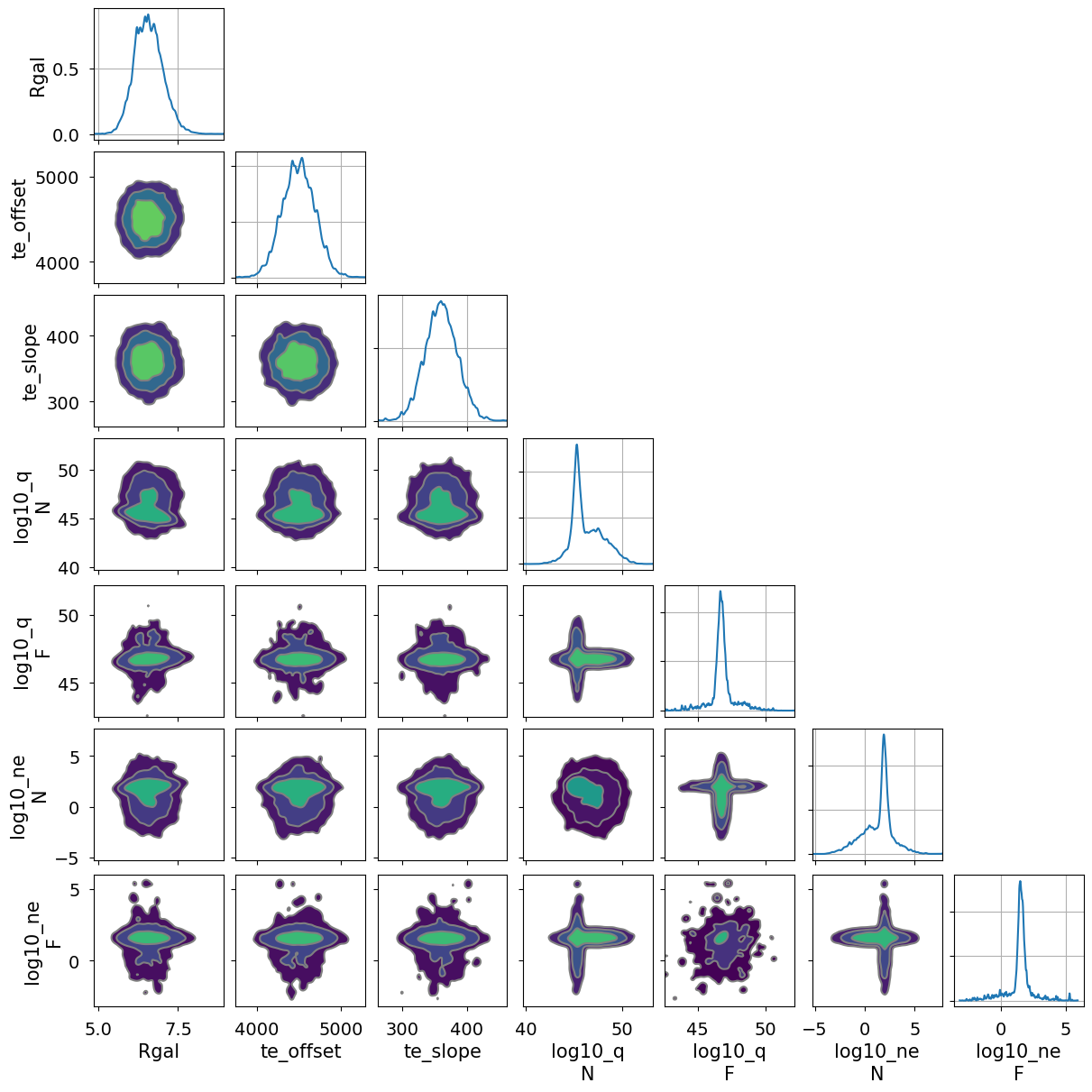
_ = pm.plot_pair(trace.posterior, marginals=True, figsize=(12, 12), kind='kde', backend_kwargs={"layout": "constrained"}, var_names=["Rgal", "te_offset", "te_slope", "log10_q", "log10_ne"])
[17]:
# sample posterior predictive
with model:
    posterior = pm.sample_posterior_predictive(trace.sel(draw=slice(None, None, 1)))
Sampling: [log10_line_obs, log10_radius_obs, vlsr_obs]
100.00% [24000/24000 00:01<00:00]
[18]:
# drop samples with distance <= 0.0
bad_distance = trace.posterior["distance"] <= 0.0

result = {}

# Hyperparameters & distance-independent parameters
params = ["te_offset", "te_slope", "Rgal", "te"]
for param in params:
    if param not in trace.posterior:
        continue
    post = trace.posterior[param].data.flatten()
    result[f"{param}_mean"] = np.mean(post)
    result[f"{param}_std"] = np.std(post)
    result[f"{param}_median"] = np.median(post)
    hdi = az.hdi(post, hdi_prob=0.90)
    result[f"{param}_hdi5"] = hdi[0]
    result[f"{param}_hdi95"] = hdi[1]

# Distance-dependent parameters
params = [
    "distance",
    "log10_q",
    "log10_ne",
    "log10_Rs",
    "log10_em",
    "log10_tau_line",
    "log10_radius_mu",
    "log10_line_mu",
]
for param in params:
    posterior_N = trace.posterior[param].sel(kdar="N").data[
        (trace.posterior["kdar_w"] == 0) * (~bad_distance.sel(kdar="N"))
    ]
    posterior_F = trace.posterior[param].sel(kdar="F").data[
        (trace.posterior["kdar_w"] == 1) * (~bad_distance.sel(kdar="F"))
    ]
    posterior_T = np.concatenate([posterior_N, posterior_F])
    for kdar, post in zip(["N", "F", "T"], [posterior_N, posterior_F, posterior_T]):
        if len(post) < 5:
            continue
        result[f"{param}_{kdar}_mean"] = np.mean(post)
        result[f"{param}_{kdar}_std"] = np.std(post)
        result[f"{param}_{kdar}_median"] = np.median(post)
        hdi = az.hdi(post, hdi_prob=0.90)
        result[f"{param}_{kdar}_hdi5"] = hdi[0]
        result[f"{param}_{kdar}_hdi95"] = hdi[1]

    result[f"{param}_samples"] = posterior_T

# KDAR weight
result["kdar_w"] = len(posterior_F)/len(posterior_T)

# Observed parameters
params = [
    "vlsr_obs",
    "log10_radius_obs",
    "log10_line_obs",
]
for param in params:
    post = posterior.posterior_predictive[param].data.flatten()
    result[f"{param}_mean"] = np.mean(post)
    result[f"{param}_std"] = np.std(post)
    result[f"{param}_median"] = np.median(post)
    hdi = az.hdi(post, hdi_prob=0.90)
    result[f"{param}_hdi5"] = hdi[0]
    result[f"{param}_hdi95"] = hdi[1]
    result[f"{param}_samples"] = post
[19]:
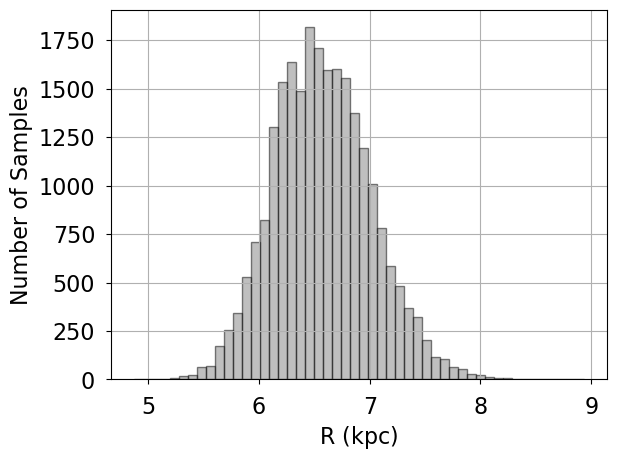
fig, ax = plt.subplots()
ax.hist(trace.posterior["Rgal"].data.flatten(), bins=50, color="gray", edgecolor="k", alpha=0.5)
ax.set_ylabel("Number of Samples")
ax.set_xlabel("$R$ (kpc)")
[19]:
Text(0.5, 0, '$R$ (kpc)')
[20]:
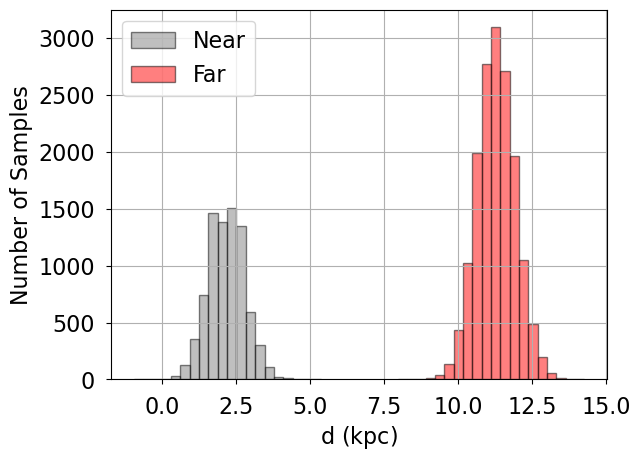
fig, ax = plt.subplots()
bins=20
ax.hist(trace.posterior["distance"].sel(kdar='N').data.flatten(), weights=(1-trace.posterior["kdar_w"].data.flatten()), bins=bins, color="gray", edgecolor="k", alpha=0.5, label="Near")
ax.hist(trace.posterior["distance"].sel(kdar='F').data.flatten(), weights=trace.posterior["kdar_w"].data.flatten(), bins=bins, color="red", edgecolor="k", alpha=0.5, label="Far")
ax.set_ylabel("Number of Samples")
ax.set_xlabel("$d$ (kpc)")
ax.legend(loc="best")
[20]:
<matplotlib.legend.Legend at 0x7bcef9072c60>
[21]:
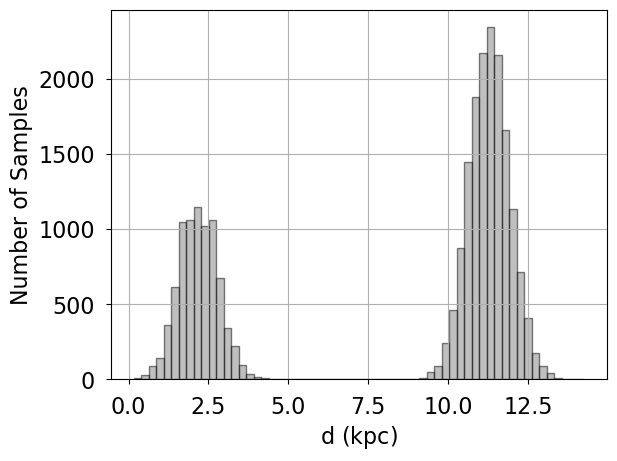
fig, ax = plt.subplots()
bins=60
ax.hist(result["distance_samples"], bins=bins, color="gray", edgecolor="k", alpha=0.5)
ax.set_ylabel("Number of Samples")
ax.set_xlabel("$d$ (kpc)")
[21]:
Text(0.5, 0, '$d$ (kpc)')
[22]:
print(result["kdar_w"])
0.6665555462955246
[23]:
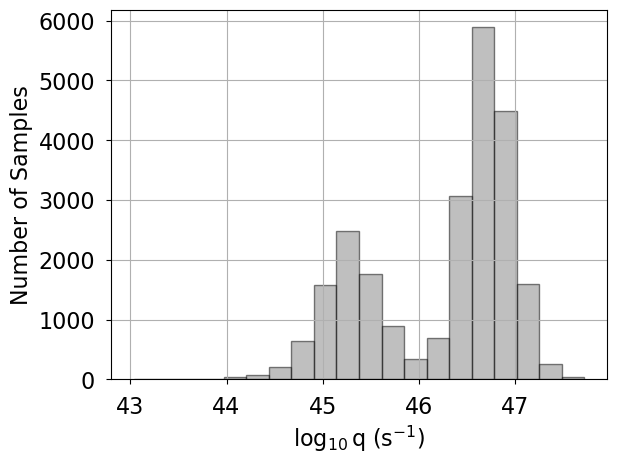
fig, ax = plt.subplots()
bins=20
ax.hist(result["log10_q_samples"], bins=bins, color="gray", edgecolor="k", alpha=0.5)
ax.set_ylabel("Number of Samples")
ax.set_xlabel(r"$\log_{10} q$ (s$^{-1}$)")
[23]:
Text(0.5, 0, '$\\log_{10} q$ (s$^{-1}$)')
[24]:
fig, ax = plt.subplots()
bins=20
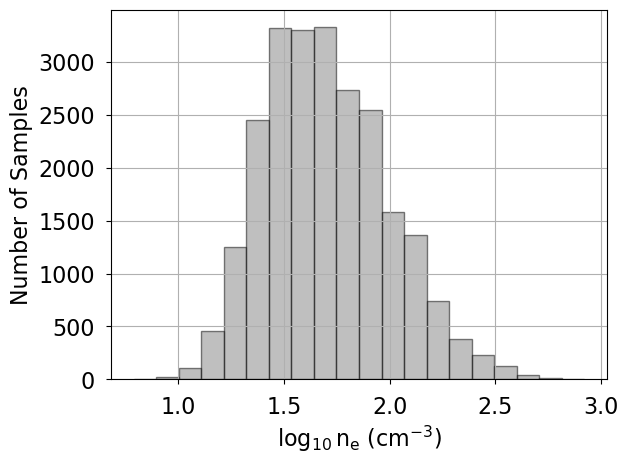
ax.hist(result["log10_ne_samples"], bins=bins, color="gray", edgecolor="k", alpha=0.5)
ax.set_ylabel("Number of Samples")
ax.set_xlabel(r"$\log_{10} n_e$ (cm$^{-3}$)")
[24]:
Text(0.5, 0, '$\\log_{10} n_e$ (cm$^{-3}$)')
[25]:
fig, ax = plt.subplots()
bins=20
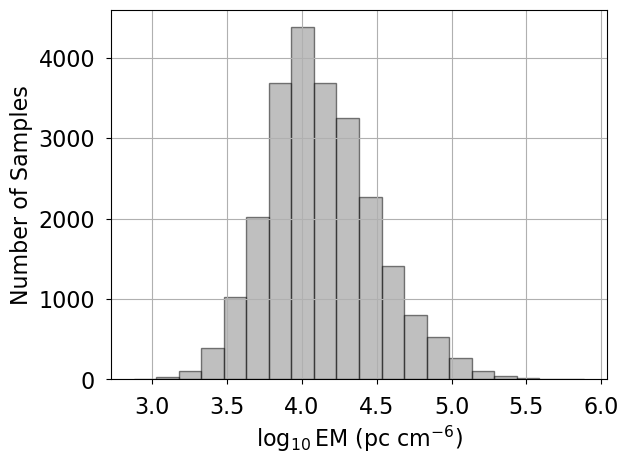
ax.hist(result["log10_em_samples"], bins=bins, color="gray", edgecolor="k", alpha=0.5)
ax.set_ylabel("Number of Samples")
ax.set_xlabel(r"$\log_{10} EM$ (pc cm$^{-6}$)")
[25]:
Text(0.5, 0, '$\\log_{10} EM$ (pc cm$^{-6}$)')
[26]:
# plot posterior predictive samples
fig, ax = plt.subplots()
bins=20
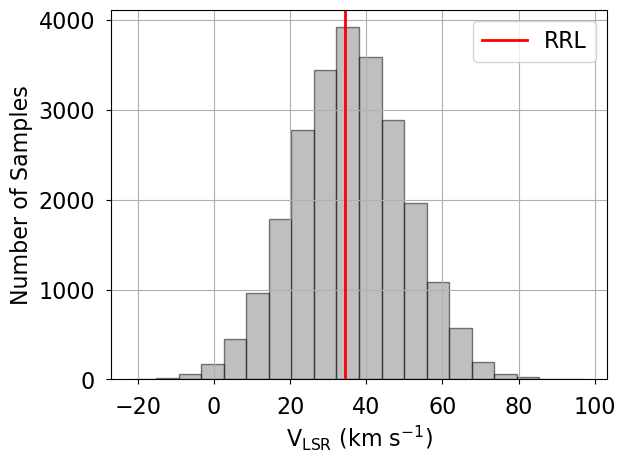
ax.hist(result["vlsr_obs_samples"], bins=bins, color="gray", edgecolor="k", alpha=0.5)
ax.axvline(data["vlsr"], color="r", lw=2, label="RRL")
ax.set_ylabel("Number of Samples")
ax.set_xlabel(r"$V_{\rm LSR}$ (km s$^{-1}$)")
ax.legend(loc="best")
[26]:
<matplotlib.legend.Legend at 0x7bcefbf9e3c0>
[27]:
# plot posterior predictive samples
fig, ax = plt.subplots()
bins=20
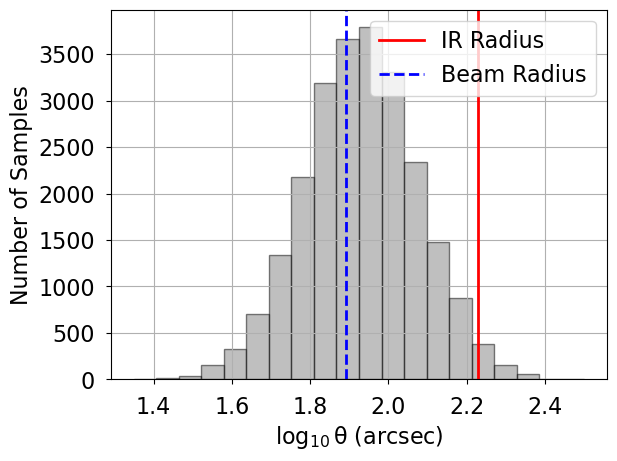
ax.hist(result["log10_radius_obs_samples"], bins=bins, color="gray", edgecolor="k", alpha=0.5)
ax.axvline(np.log10(data["radius"]), color="r", lw=2, label="IR Radius")
beam_radius = np.sqrt(data["beam_area"]*4.0*np.log(2.0)/np.pi)
ax.axvline(np.log10(beam_radius), color="b", lw=2, ls="--", label="Beam Radius")
ax.set_ylabel("Number of Samples")
ax.set_xlabel(r"$\log_{10} \theta$ (arcsec)")
ax.legend(loc="best")
[27]:
<matplotlib.legend.Legend at 0x7bcefc3e7050>
[28]:
# plot posterior predictive samples
fig, ax = plt.subplots()
bins=20
ax.hist(10.0**result["log10_radius_obs_samples"], bins=bins, color="gray", edgecolor="k", alpha=0.5)
ax.axvline(data["radius"], color="r", lw=2, label="IR Radius")
beam_radius = np.sqrt(data["beam_area"]*4.0*np.log(2.0)/np.pi)
ax.axvline(beam_radius, color="b", lw=2, ls="--", label="Beam Radius")
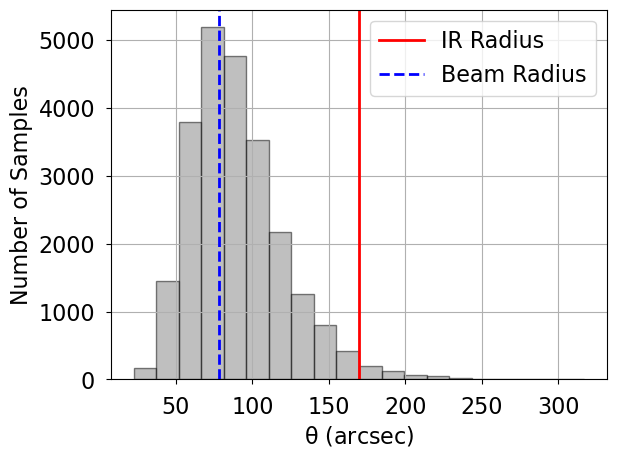
ax.set_ylabel("Number of Samples")
ax.set_xlabel(r"$\theta$ (arcsec)")
ax.legend(loc="best")
[28]:
<matplotlib.legend.Legend at 0x7bcefc3e63c0>
[29]:
# plot posterior predictive samples
fig, ax = plt.subplots()
bins=20
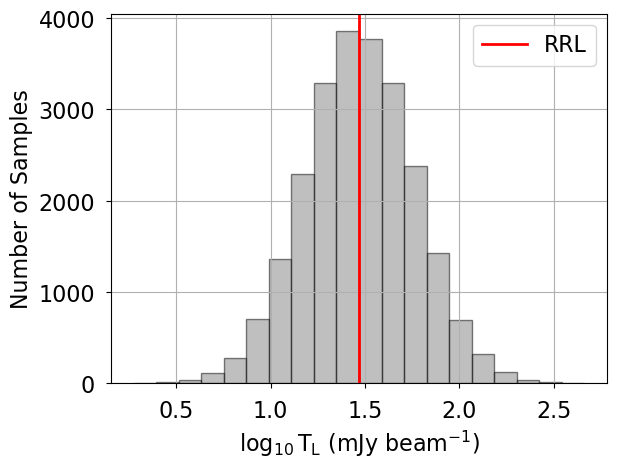
ax.hist(result["log10_line_obs_samples"], bins=bins, color="gray", edgecolor="k", alpha=0.5)
ax.axvline(np.log10(data["line"]), color="r", lw=2, label="RRL")
ax.set_ylabel("Number of Samples")
ax.set_xlabel(r"$\log_{10} T_L$ (mJy beam$^{-1}$)")
ax.legend(loc="best")
[29]:
<matplotlib.legend.Legend at 0x7bcefc0a63c0>
[30]:
# plot posterior predictive samples
fig, ax = plt.subplots()
bins=20
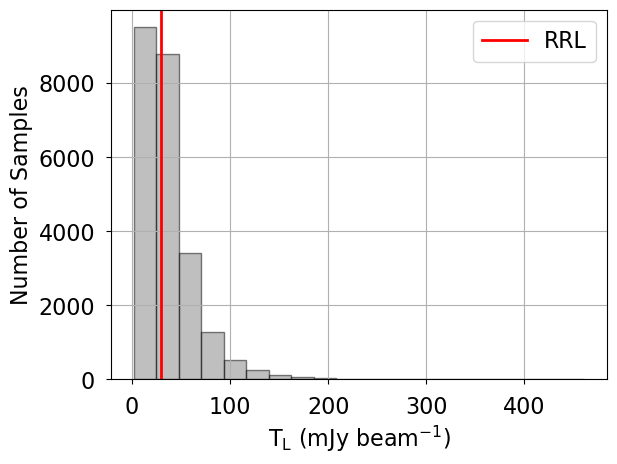
ax.hist(10.0**result["log10_line_obs_samples"], bins=bins, color="gray", edgecolor="k", alpha=0.5)
ax.axvline(data["line"], color="r", lw=2, label="RRL")
ax.set_ylabel("Number of Samples")
ax.set_xlabel(r"$T_L$ (mJy beam$^{-1}$)")
ax.legend(loc="best")
[30]:
<matplotlib.legend.Legend at 0x7bcefbee88c0>
[ ]: